Verified AI for when you can't afford to be wrong

Deep Research you can trust.

VeriLM Deep Research produces a different category of accuracy, depth, and consistency that the other providers can't match.
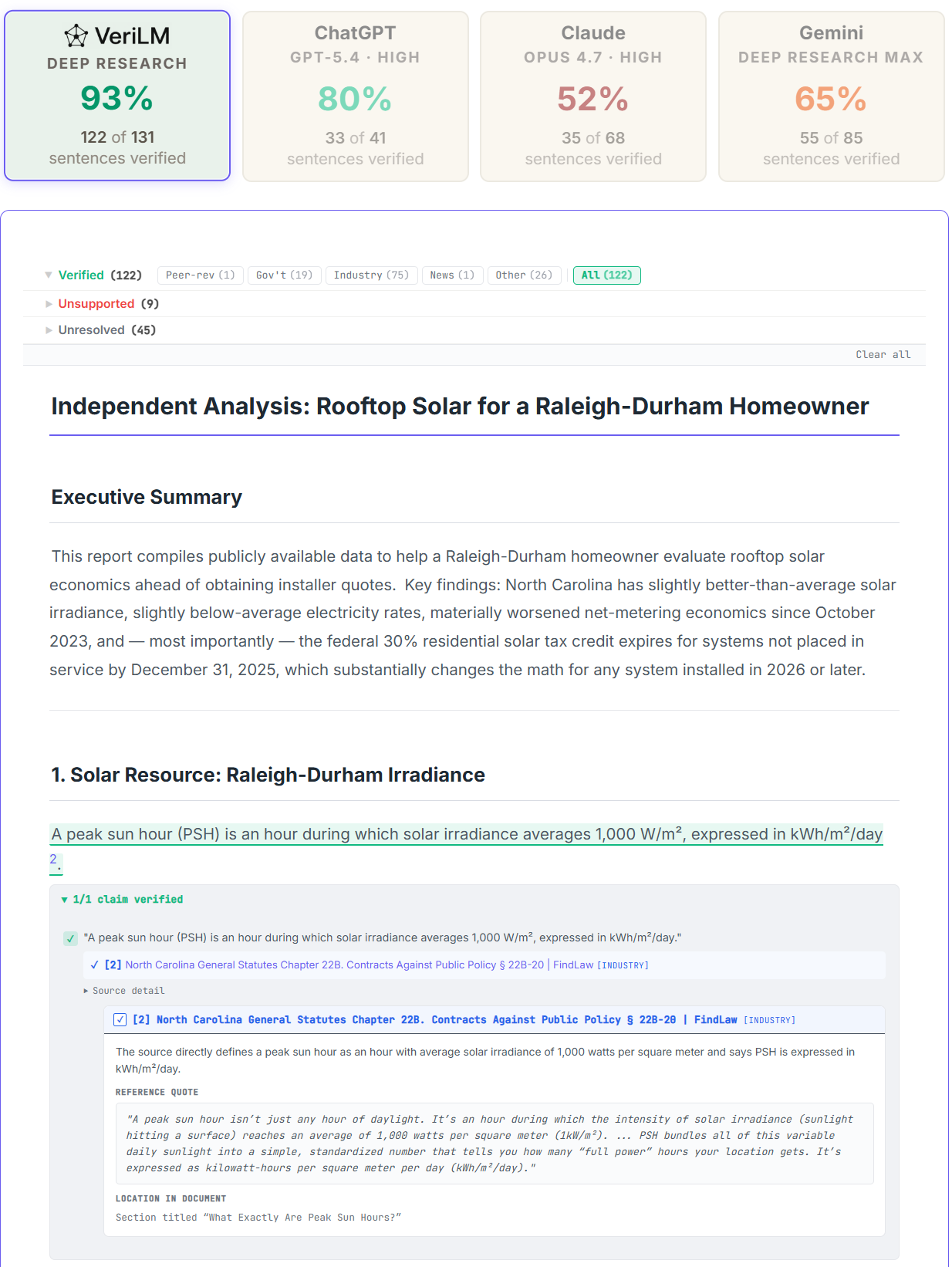
VeriLM Deep Research example report: scorecard at top shows comparative accuracy across four Deep Research tools (VeriLM 97 percent with 120 of 124 sentences verified, ChatGPT 74 percent, Claude 52 percent, Gemini 51 percent); below, a Key Takeaways bullet has its claims expanded to show two sources verified against the original cited material, with the actual reference quote from one source shown in a Source Detail panel.

What you're seeing: comparative accuracy across four Deep Research tools (top), and a verified claim with its source detail expanded (below). Click into the live report further down to try it yourself.

Every claim, traceable. Every source, inspectable. Finally, a Deep Research report you can trust: accurate, thorough, consistent, with the embedded grading of every sentence back to the source to prove it.

Here's one example from that test set: the same Raleigh-Durham solar economics question, run through all four tools. Click into any report and use the Verified, Unsupported, and Unresolved dropdowns to see how each claim was scored.
Deep thinking you can trust.

Deep Think is for the questions where your time is valuable and you can't afford to be wrong — where a wrong assumption costs days and a missed nuance changes the conclusion.

The question you ask is rarely as clear as you think. Unstated assumptions can break everything. So Deep Think starts with a scope definition phase: VeriLM works with you to surface those assumptions, clarify ambiguity, and lock down a precise prompt before any model touches it.

Then your question runs through frontier models at their deepest reasoning budgets. What comes back isn't a chat reply — it's a report: executive summary up top, rigor on every assumption, limitations stated plainly, what would change the answer, and common nomenclature across every model's contribution.

The result: a standalone artifact that holds up under scrutiny — VeriLM Deep Think is the antidote for work slop.

How it works

1

Scope Definition

Before anything runs, VeriLM works with you to understand what you actually need. It asks the right questions, clarifies ambiguities, and crafts a precise prompt — the kind most people don't have time to write themselves.

2

Independent Analysis

That prompt goes to multiple models simultaneously, each working the problem in isolation. No model sees another's output. This eliminates the groupthink that undermines simpler approaches.

3

Validated Synthesis

An independent model evaluates all responses — confirming where they converge, identifying where they disagree, and explaining why. You get a verified answer with a clear confidence assessment.

Then keep going. VeriLM is multi-turn — once you have your validated answer, you can follow up with the full panel or drill into a single model for focused exploration.

Where it matters

Engineering & Science

Complex derivations, trade-off analyses, and technical problems where a single model's blind spots can send you down the wrong path for days.

Medical & Clinical

AI is not a substitute for a doctor's advice. But when the stakes are high — a diagnosis to understand, a drug interaction to check, literature to synthesize — Deep Think gives you defensible information you can take to your provider.

Financial Analysis

Modeling assumptions, regulatory interpretation, and quantitative reasoning where models routinely produce plausible but contradictory conclusions.

Legal Research

Case law analysis, contract review, and regulatory questions where citation accuracy and logical consistency are non-negotiable.

At the frontier

Everything above is about verification — getting reliable answers to known-hard questions. But we're curious about what happens at the boundary, where nobody knows the answer yet. Independent models reasoning about open problems might disagree in ways that are more useful than any single model's confident answer. If you're a researcher working at the edge of your field, we'd love to find out together.

Capabilities

Rich inputs. PDFs, images, tables, and text — bring the actual source material.

Code execution & web search. Models can write and run code, and search the web when a problem requires it.

Frontier model access. Claude Opus 4.7, GPT-5.5 Pro, Gemini 3.1 Pro — used together or individually.

Right-sized analysis. Not every question needs frontier models. VeriLM scales from fast to thorough.

Multi-turn conversations. Follow up with the full panel or drill into a single model for focused work.

Your data stays yours. Queries are not used to train any model.

Example

The example below is a real engineering question: how does adding distributed propellers to a wing change its lift-to-thrust ratio in static conditions? All three frontier models independently derived the same closed-form formula. Then one — Gemini — raised a physical objection the others didn't engage: applied past a certain point, the formula predicts a wing producing more lift than the propellers produce thrust, which is physically impossible.

Deep Think held the verdict at Medium confidence rather than High because that validity concern wasn't resolved. Two models agreeing on the math isn't the same as two models being right about its domain of application — and when verification means anything, it has to include the case where the consensus itself needs questioning.

Explore the full output below — executive summary, derivation, expert divergence, and sensitivity analysis. Then try Deep Think yourself.

Everyday answers you can trust.

Daily Driver looks and feels like chat. You ask, you get an answer, you ask a follow-up — same speed, same rhythm you're used to.

Behind every answer is a team of models. Each one has slightly different training and a slightly different worldview. Daily Driver runs your question through all of them, then has one model check the others' work before the answer reaches you: you see what each said, what they agreed on, and where they diverged.

VeriLM picks the right thinking depth for each model on your behalf, so you don't have to think about it — but you see exactly what was used in the result. If you think it needs more thought, ask for it, or follow up with a focused Single Model or Deep Think.

Daily Driver searches the web, runs code, and generates charts and graphics — the everyday capabilities of a frontier model, with multi-model verification baked in.

Example

A user asked: how did a static 80/20 stock/bond portfolio perform against Vanguard's 2030 and 2025 Target Date Funds over the past decade? The three frontier models agreed on the ranking and matched on the Target Date Fund returns — but came in slightly apart on the 80/20 figure (Claude and Gemini at 11.87%, ChatGPT at 12.17%).

Analysis 1 is the verified-consensus answer with that small divergence transparently flagged.

Analysis 2 is the follow-up reconciliation. The three models' actual outputs are inspected, the methodological fork is identified (rebalancing convention), the mechanics are explained — and, critically, where the explanation hits its limit, that's flagged honestly rather than papered over.

Click between the two to see the full flow. Then try Daily Driver yourself.

Any frontier model you can trust.

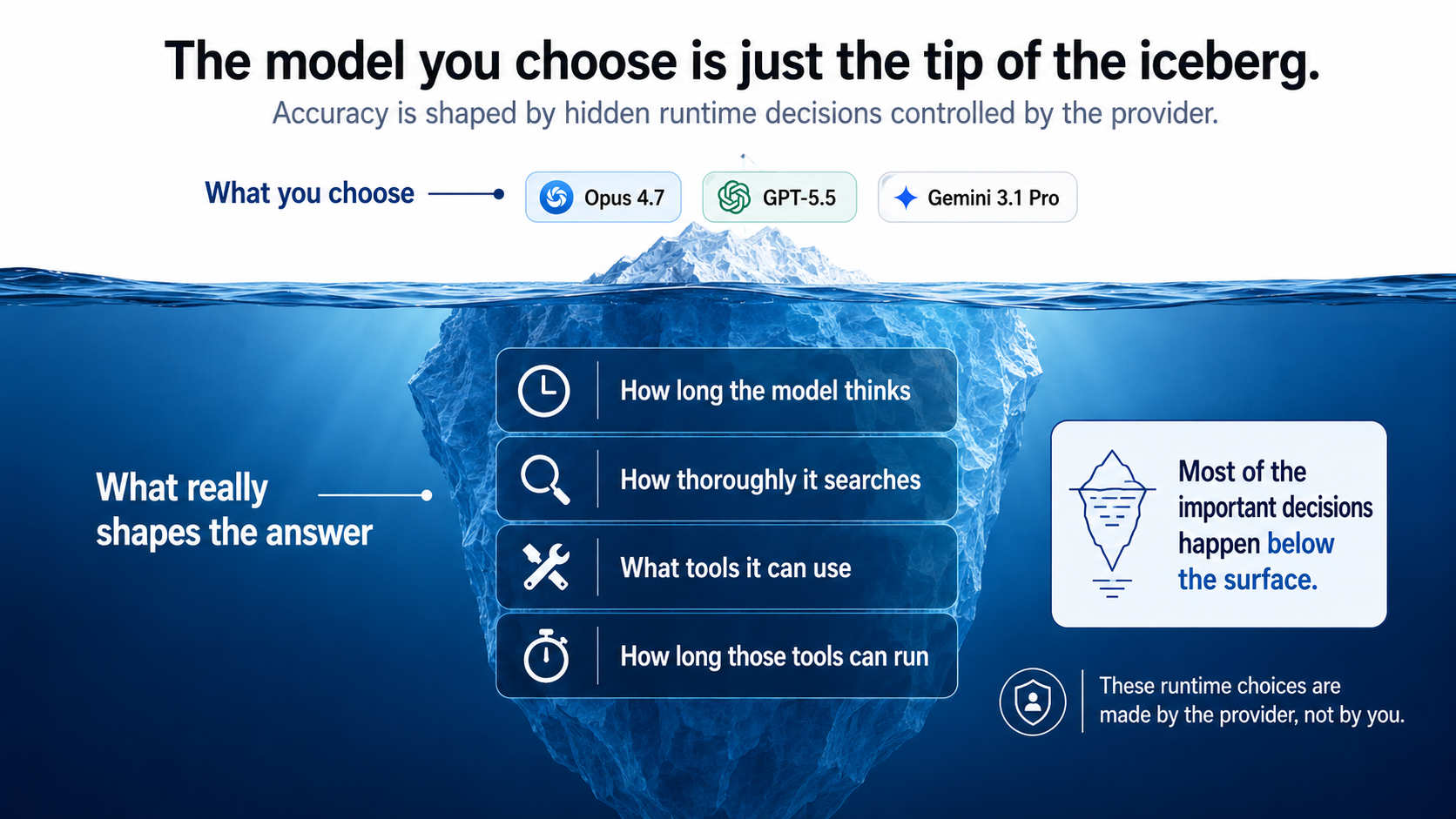
Picking "Opus 4.7" or "GPT-5.5" is the tip of the iceberg. The choices that determine the accuracy of your answer — how long the model thinks, how thoroughly it searches, what tools it can use and for how long — are beneath the surface.

With VeriLM, you have control and transparency: Because VeriLM uses the provider APIs directly, you decide how each query runs, and you see exactly what produced the answer. Pricing will pair a flat subscription with usage — so we have no incentive to limit how much the model thinks, searches, or uses tools on your behalf. The best answer wins.

Iceberg diagram: chosen model names (Opus 4.7, GPT-5.5, Gemini 3.1 Pro) shown above water; underwater section shows the dials 'How long the model thinks', 'How thoroughly it searches', 'What tools it can use', 'How long those tools can run' — captioned 'Most of the important decisions happen below the surface. These runtime choices are made by the provider, not by you.'

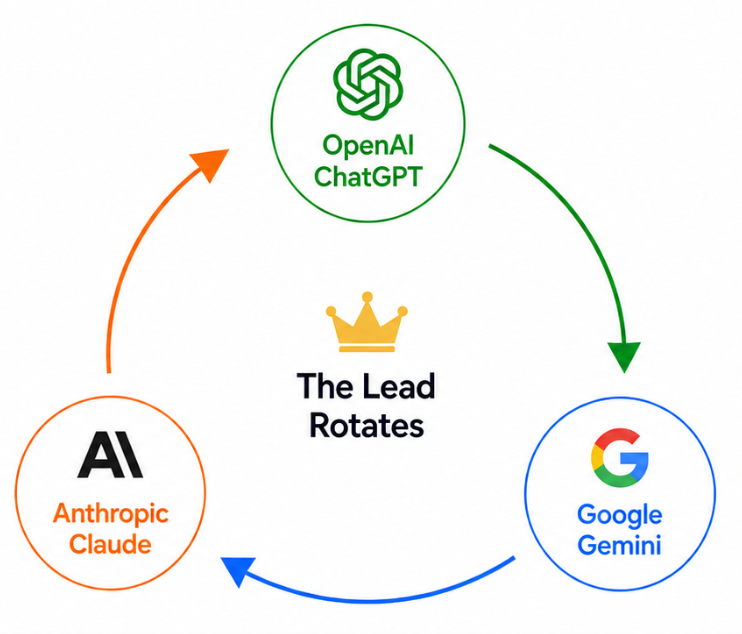
One more piece. Even with API-level control over one provider, the frontier itself rotates. OpenAI takes the lead. Then Anthropic. Then Google. Then OpenAI again.

The result? Three subscriptions. An ever-rotating guessing game over which model is best for this question, and data scattered across three browser tabs — hunting for which provider had that conversation last week.

Three-node rotation diagram: OpenAI ChatGPT, Google Gemini, and Anthropic Claude with arrows cycling between them; a crown in the center is labeled 'The Lead Rotates.'

VeriLM gives you every frontier model the providers expose through their APIs, at the thinking level you choose — including GPT-5.5 Pro, which otherwise requires a $100/month ChatGPT Pro plan. You pick the model. You set how it runs. You see what produced the answer.

The same is true on every other mode of VeriLM. Deep Think, Daily Driver, and Deep Research run through the providers' APIs the same way — so the control and transparency you have on a single question carry through to a thirty-step analysis.

Consumer chat VeriLM
You control The label you pick How each query actually runs
You see The answer The answer + what produced it
You pay Flat fee per provider Subscription + usage
You get Multiple logins, scattered data, rate limits One subscription, one history, one search

How VeriLM compares

A side-by-side look at how VeriLM compares with Perplexity Council on the dimensions that matter for AI you can trust.

Multi-model Architecture Model Control and Transparency Code execution and Artifact generation Source verification & drill-down Aligned pricing incentives
Multiple frontier providers consulted in parallel User has model control and/or transparency Runs code, returns artifacts (plots, etc.), shows individual model results Statement-to-source grading; user can audit reasoning Metered model rewards quality over speed/cost
Perplexity Council Yes OpenAI + Anthropic + Google ×No Opaque; provider decides ×No Not available ×No No claim-to-source grading ×No Flat $200/mo unlimited
VeriLM Daily Driver Yes OpenAI + Anthropic + Google Yes Orchestrator chooses; Transparent to user Yes Available ×No No claim-to-source grading Yes Metered credits
VeriLM Deep Think Yes OpenAI + Anthropic + Google Plus Clarifying Questions Yes User Controls Thinking Level Yes Available ×No No claim-to-source grading Yes Metered credits
VeriLM Deep Research Yes OpenAI + Anthropic + Google Deep Research Tiers Yes Fixed pipeline; Transparent to user ×No Not available Yes Grade cited sentences claim-by-claim Yes Metered credits

Request Beta Access

We're onboarding professionals in small batches.

Request received

We'll reach out when a seat opens in the next testing block.